- Acid: has a pH less than 7.0.
- Alkaline: has a pH greater than 7.0.
- Anionic: anionic surfactants negatively charged in water.
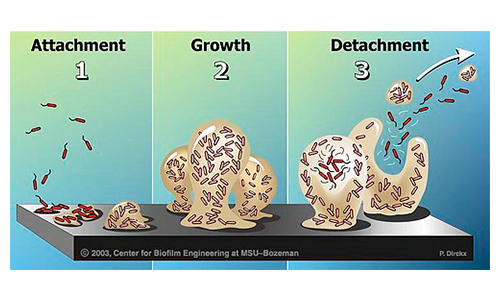
- Biofilm: a complex structure of different microorganisms adhering to a surface and protected y a glue-like carbohydrates secreted by the microorganisms. Once the microorganisms attach to food contact surfaces as a biofilm, they are very difficult to completely remove.
- Cationic: cationic surfactants positively charged in water (e.g. quats).
- Clean break: a break in production where all the food contact surfaces on the production line are cleaned and sanitized with a documented, verified, and validated process. A clean break can be documented after cleaning and sanitizing, thus separating the products processed before and after cleaning and sanitizing which can minimize the amount of product subject to a recall.
- Clean water: has no detectable generic E. coli in a 100 mL sample. Use clean water for all cleaning and sanitizing steps.
- Cleaner: a chemical cleaning compound. To ensure effectiveness, cleaners should be chosen based on factors such as the type of soil (e.g. carbohydrate- or fat-based) that needs to be removed and the type of surface material to be cleaned. Follow cleaner label instructions.
- Cleaning: the physical removal of dirt from surfaces which can include the use of clean water and cleaners. To choose the appropriate cleaner, consider factors such as the type of soil to be removed and the surface material to be cleaned. It is important to clean the surface first because dirty surfaces cannot be sanitized.
- Food contact surface: those surfaces that contact human food and those surfaces from which drainage, or other transfer, onto the food or onto surfaces that contact the food ordinarily occurs during the normal course of operations. Examples include produce washing sinks, harvest tools, tables used for packing, tools/equipment for storing and transporting produce, and processing equipment. Food contact surfaces should be smooth and nonporous to allow for easy and effective cleaning and sanitizing.
- Neutral: has a pH of 7.0.
- Nonionic: neither cationic nor anionic; does not dissociate in water.
- Sanitizing: the treatment of a cleaned surface to reduce or eliminate microorganisms to safe levels according to public health standards. For food contact surfaces, this means a reduction of the contamination level by 99.999% within 30 seconds. Before sanitizing, make sure the surface is clean and that all soil and detergent have been removed from the surface.
- Sanitizer: a substance that reduces the number of microorganisms to acceptable levels according to public health standards, typically for use on food contact surfaces. Some examples include chlorine bleach and peroxyacetic acid. Factors such as pH, concentration, and temperature influence the efficacy of sanitizing solutions. Choose products that are labeled for the appropriate use and follow label instructions to ensure effective and safe use.
- Soil: unwanted matter or debris on a surface. There are different types of soils (e.g. organic and inorganic), and they may be soluble in water, alkali, and/or acid solutions.
- Surfactant: promotes the cleaning action (e.g. wetting ability) of a solution by allowing closer contact between soil and cleaner.
- Water hardness: the amount of salts (e.g. magnesium chloride) present in water.